
Spin Coater Machine: A Laboratory Evaluation Framework for Research Procurement
Selecting a spin coater machine is rarely a straightforward equipment purchase. For research laboratories, it is a long-term investment in experimental capability. The right system should support not only your projects today but also future research, changing materials, new researchers, and evolving laboratory workflows. Yet many evaluation processes begin with specification sheets—comparing maximum RPM, motor power, or purchase price. While these parameters have their place, they rarely determine whether a machine continues to deliver value five years after installation.
Laboratories that achieve consistent research outcomes typically evaluate a spin coater machine differently. They begin with the research workflow, assess how the machine fits into that workflow, and only then compare technical specifications and commercial proposals. This article introduces a Laboratory Evaluation Framework (LEF)—a structured approach that helps researchers, principal investigators, laboratory managers, and procurement teams evaluate a spin coater machine beyond brochure comparisons.
Quick Answer: What Is a Spin Coater Machine?
A spin coater machine is a laboratory instrument designed to deposit uniform thin films by rotating a substrate at controlled speeds while a liquid material spreads across its surface. Modern research systems combine a precision drive system, programmable controller, substrate holding mechanism, enclosed process chamber, and software interface to support repeatable coating workflows across a range of thin-film research applications.
Unlike production equipment, research spin coaters are expected to accommodate changing materials, different substrate formats, and evolving experimental requirements over many years.
Key Takeaways
- A spin coater machine is part of a complete laboratory workflow, not just a rotating platform.
- Successful equipment selection starts with research requirements before technical specifications.
- Multiple stakeholders influence procurement decisions.
- Machine architecture affects long-term usability as much as published performance figures.
- Future adaptability is often more valuable than selecting equipment for a single project.
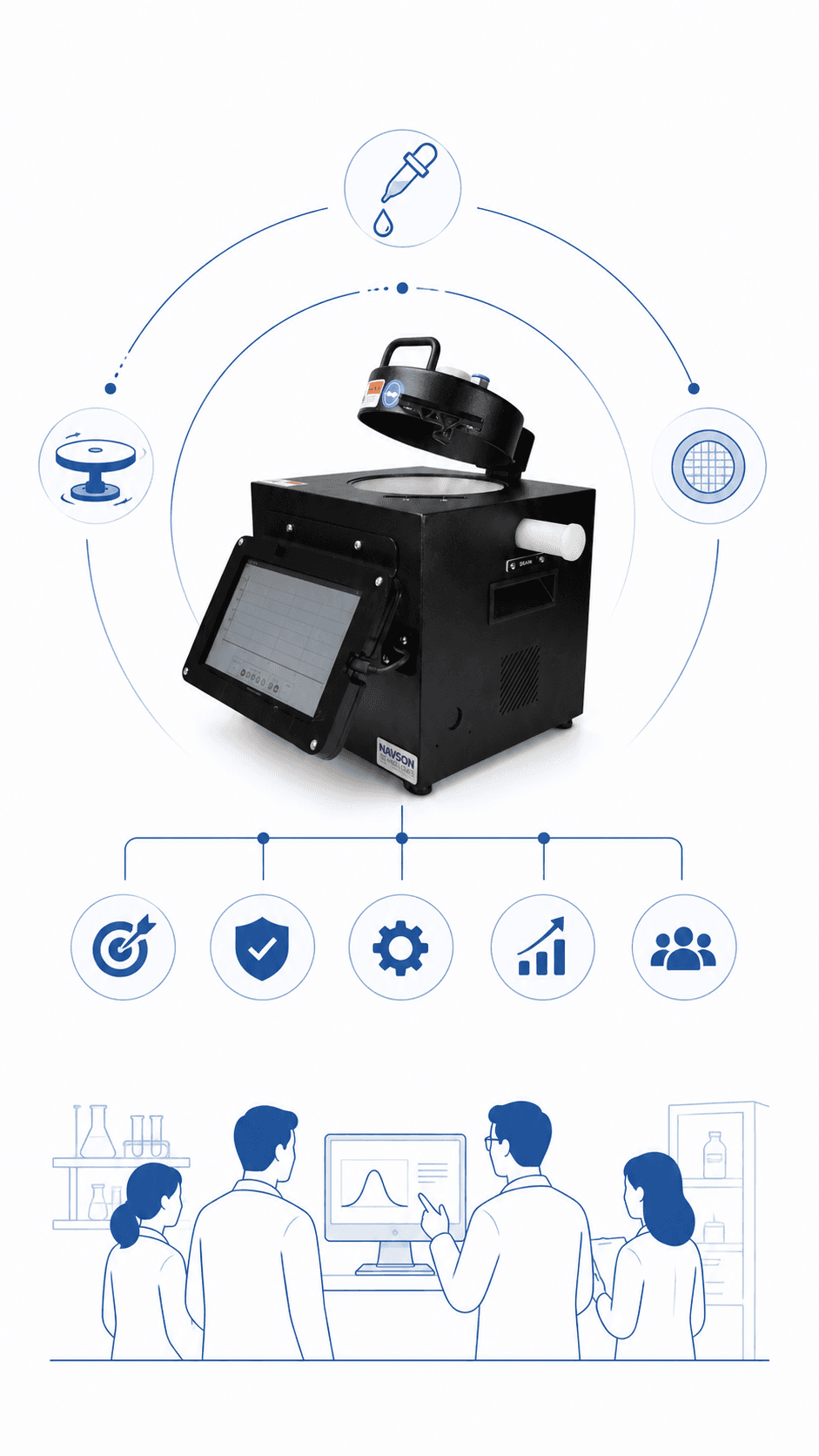
The Laboratory Evaluation Framework
Most laboratories compare equipment using specification sheets. The Laboratory Evaluation Framework takes a broader view by evaluating how well a spin coater machine supports the complete research lifecycle. Rather than asking “Which machine has the highest specifications?”, the framework asks:
“Which machine will continue supporting reliable research as our laboratory evolves?”
The LEF consists of five evaluation layers.
| Evaluation Layer | Primary Question |
|---|---|
| Research Fit | Does the machine support current and future research? |
| Machine Architecture | Is the system engineered for long-term laboratory use? |
| Workflow Integration | Will it fit naturally into daily laboratory operations? |
| Procurement Readiness | Does the supplier provide the documentation and support required? |
| Future Scalability | Can the platform grow with new research requirements? |
Each layer addresses a different aspect of laboratory decision-making, helping teams evaluate equipment from both technical and operational perspectives.
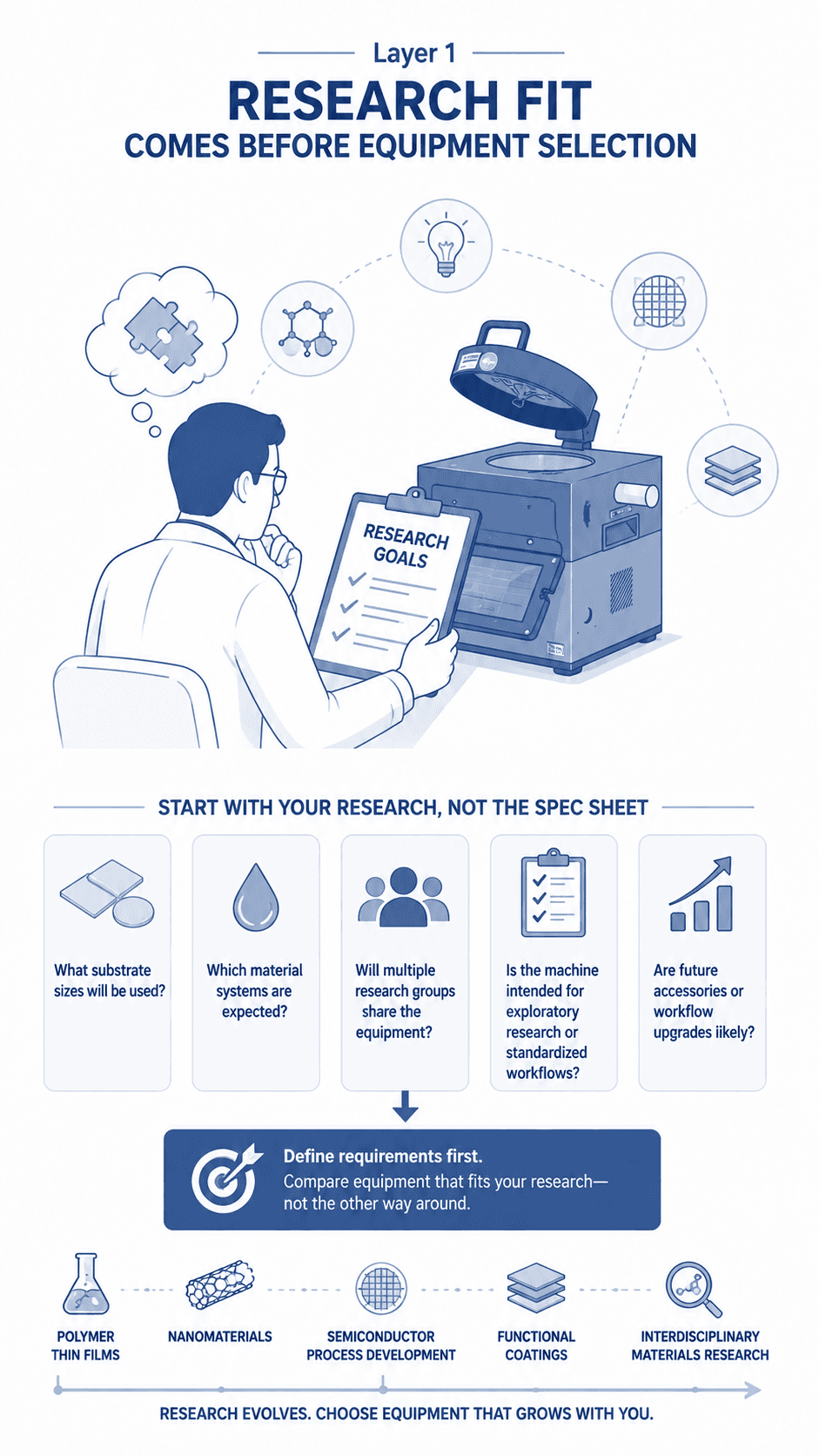
Layer 1: Research Fit Comes Before Equipment Selection
One of the most common procurement mistakes is choosing equipment before clearly defining the research it is expected to support.
Research projects evolve. A laboratory investigating polymer thin films today may later expand into nanomaterials, semiconductor process development, functional coatings, or interdisciplinary materials research. Selecting a spin coater machine based solely on immediate requirements can limit future capability.
Before requesting quotations, laboratories should document questions such as:
- What substrate sizes will be used?
- Which material systems are expected?
- Will multiple research groups share the equipment?
- Is the machine intended for exploratory research or standardized workflows?
- Are future accessories or workflow upgrades likely?
Answering these questions first allows equipment comparisons to be based on laboratory requirements rather than marketing specifications.
Layer 2: Evaluate the Machine, Not Just the Specifications
A research spin coater machine is an integrated system made up of several functional components. Evaluating only performance numbers provides an incomplete picture of how the equipment will operate over years of laboratory use.
Key elements worth assessing include:
| Machine Component | Why It Matters |
|---|---|
| Drive System | Provides stable rotational control throughout the coating cycle. |
| Controller | Enables programmable process recipes and repeatable operation. |
| Substrate Holder (Chuck) | Secures samples of different sizes and materials during processing. |
| Process Chamber | Contains the coating process while supporting cleanliness and routine maintenance. |
| Safety Enclosure | Protects users while reducing process disruption from the surrounding environment. |
| Software Interface | Simplifies recipe management, operator training, and repeatability. |
Looking at the machine as a complete system helps laboratories evaluate long-term usability rather than isolated technical parameters.
Expert Insight
Experienced research groups rarely purchase a spin coater machine because it offers the highest published specification. They invest in platforms that integrate smoothly into laboratory workflows, remain usable across multiple research projects, and continue supporting new users without introducing unnecessary operational complexity.
Layer 3: Evaluate How the Spin Coater Machine Fits Your Laboratory Workflow
A technically capable spin coater machine may still become a poor long-term investment if it introduces unnecessary complexity into daily laboratory operations. For research laboratories differ from production environments and an equipment is often used by PhD scholars, research associates, postdoctoral fellows, and visiting researchers with varying levels of experience. As projects evolve, the same machine may support multiple materials, substrates, and experimental procedures. For this reason, laboratories should evaluate how easily the machine integrates into routine work—not just how it performs under ideal conditions.
Consider questions such as:
- Is the operator interface intuitive for new users?
- Can process recipes be saved and recalled consistently?
- Is routine chamber cleaning straightforward?
- Can substrate holders be changed efficiently?
- Is the machine suitable for shared laboratory environments?
Reducing operational friction improves productivity over the lifetime of the equipment and simplifies training as new researchers join the laboratory.
Layer 4: Procurement Extends Beyond the Quotation
Selecting a spin coater machine is not only a technical decision—it is also an institutional procurement exercise. Universities, government laboratories, and industrial R&D centers typically require technical documentation before approving equipment purchases. Delays often arise because essential information is requested after supplier evaluation has already begun. Preparing a procurement checklist early helps streamline the evaluation process.
Procurement Readiness Checklist
| Requirement | Why It Matters |
|---|---|
| Technical specifications | Confirms system capabilities |
| Configuration details | Ensures suitability for the intended application |
| Installation requirements | Helps laboratories prepare infrastructure |
| User documentation | Supports operator training |
| Warranty information | Clarifies long-term support |
| Maintenance guidance | Assists lifecycle planning |
| Optional accessories | Enables future expansion without replacing the system |
A complete technical proposal allows procurement teams to evaluate competing solutions on consistent criteria rather than incomplete quotations.
Layer 5: Think Beyond Today’s Research
One characteristic shared by successful research laboratories is that they rarely purchase equipment for a single experiment. Instead, they invest in platforms capable of supporting future research directions.
A spin coater machine purchased for thin-film materials today may later contribute to interdisciplinary projects involving advanced coatings, functional materials, or emerging fabrication techniques. Choosing a platform with flexibility for future accessories, software updates, or different substrate configurations can extend the useful life of the equipment. This approach not only protects the initial investment but also reduces the disruption associated with replacing equipment as research priorities evolve.
Machine Evaluation Checklist
Before requesting quotations, laboratories should evaluate a spin coater machine across five practical areas.
| Evaluation Area | Questions to Ask |
|---|---|
| Research Requirements | Does it support current and anticipated research projects? |
| Machine Design | Is the overall architecture suitable for long-term laboratory use? |
| Workflow Integration | Will researchers be able to operate it consistently? |
| Procurement Support | Is the technical documentation complete? |
| Future Expansion | Can the system adapt as laboratory needs change? |
Using a structured framework helps ensure that technical, operational, and commercial considerations are evaluated together rather than in isolation.
Why This Framework Matters
Research equipment is often expected to remain in service for many years. During that time, laboratory personnel change, research programmes evolve, and experimental requirements become more sophisticated.
A structured evaluation framework shifts the discussion from “Which machine looks best today?” to “Which platform will continue supporting reliable research over time?”
This perspective encourages more informed purchasing decisions and helps laboratories build equipment capability that grows alongside their research.
Expert Insight
In research environments, the most expensive procurement mistake is not necessarily purchasing the wrong machine—it is selecting a system that cannot adapt as research evolves. Laboratories frequently expand into new materials, substrate formats, and collaborative projects. Evaluating flexibility at the procurement stage often delivers greater long-term value than focusing solely on initial specifications or purchase price.
Quick Answers
Begin with your laboratory’s research objectives, then assess machine architecture, workflow compatibility, supplier documentation, and future scalability. This provides a more complete evaluation than comparing specifications alone.
Not necessarily. The most suitable spin coater machine is one that aligns with laboratory workflows, research requirements, and long-term operational needs rather than simply offering the highest published specifications.
Machine architecture influences usability, maintenance, operator training, and the ability to support different research activities over time. Evaluating the complete system helps laboratories make more sustainable procurement decisions.
A spin coater machine is used to produce uniform thin films on substrates such as silicon wafers, glass, ceramics, metals, and engineered materials. It is widely used in university laboratories, government research institutions, semiconductor R&D, nanotechnology, and advanced materials research where controlled thin-film deposition is required.
Research-grade systems are designed for laboratories that require precision, repeatability, and process flexibility. Typical users include:
1. Universities
2. Research institutes
3. Government laboratories
4. Semiconductor R&D centers
5. Materials science laboratories
6. Nanotechnology research groups
Unlike educational demonstration equipment, research systems are intended to support evolving experimental workflows over extended periods.
Rather than comparing specifications alone, begin by defining:
· research objectives,
· substrate dimensions,
· laboratory environment,
· expected users,
· future expansion plans,
· documentation requirements.
Once these requirements are clear, evaluate machine architecture, workflow compatibility, and long-term support before requesting commercial quotations.
Important evaluation areas include:
· programmable process control,
· substrate holding mechanism,
· drive system stability,
· software interface,
· chamber accessibility,
· maintenance requirements,
· accessory compatibility,
· documentation and technical support.
The appropriate combination depends on the intended research workflow rather than any single specification.
Many research laboratories prefer equipment platforms that can accommodate future accessories or configuration changes as research programs evolve. Expansion options vary between manufacturers, so laboratories should discuss anticipated future requirements during the evaluation stage.
Yes. For institutional purchases, technical support often extends beyond installation. Laboratories should evaluate documentation quality, application guidance, operator training resources, warranty terms, and long-term service capability alongside technical specifications.
Related Resources
If you are comparing systems for a specific application or procurement stage, the following resources provide more detailed guidance:
- Spin Coater – Overview of research-grade spin coating systems and laboratory applications.
- Spin Coater India – Procurement considerations, support, and research requirements for Indian laboratories.
- Spin Coater Germany – Thin-film process reliability and evaluation considerations for European semiconductor and university research.
- Spin Coater Price – Factors that influence system pricing, configuration, and total procurement cost.
- SU-8 Spin Coating Machine – Guidance for laboratories working with thick photoresists and specialized lithography workflows.
Together, these resources provide a structured knowledge base covering equipment selection, regional procurement, pricing, and application-specific considerations without duplicating information across pages.
Research Validation
Laboratory equipment is often evaluated using a combination of technical specifications, supplier documentation, and evidence of real-world research use.
Independent peer-reviewed publications can provide additional confidence that a platform has supported published experimental work in academic and research environments. While every laboratory should validate equipment against its own process requirements, documented research usage is frequently considered during technical evaluation and procurement.
Final Expert Perspective
The performance of a spin coater machine is determined by more than its published specifications. Successful laboratories evaluate how the complete system supports their research—from machine architecture and operator workflow to documentation, service, and future adaptability.
The Laboratory Evaluation Framework (LEF) presented in this guide offers a practical method for assessing equipment from a long-term research perspective. By considering research fit, machine architecture, workflow integration, procurement readiness, and future scalability together, laboratories can make decisions that remain valuable well beyond the initial purchase.
Speak With an Application Engineer
Every laboratory has unique research objectives, substrate requirements, and process workflows. Discussing these requirements before procurement helps identify a configuration aligned with your research rather than selecting equipment based solely on catalogue specifications.
Whether you are establishing a new laboratory, expanding thin-film research capabilities, or replacing existing equipment, a technical discussion can help define the most suitable system architecture for your application.