
Spray Pyrolysis: Thin Film Method to Reliable Lab-Scale System Design
For many materials research labs across India—from the premier institutions in Bengaluru and Pune to the emerging research centers in Chennai—a familiar bottleneck arises. The chemistry shows promise, and the initial results are encouraging, but reproducibility begins to drift. Data becomes difficult to replicate, and scaling beyond small, controlled samples proves elusive. At that stage, the limitation is rarely scientific; it is a failure of process control. This pattern is increasingly observed across Indian research labs evaluating spray pyrolysis for thin film deposition and system-level implementation without vacuum infrastructure.
Vacuum-based deposition systems like CVD or sputtering provide the necessary control, but they often carry capital expenditures of ₹15–50 lakh, which introduce infrastructure and process overheads not required for many thin film research workflows. Spin coating offers simplicity for small samples but fails as soon as substrate size or layer thickness requirements grow. Manual and semi-controlled setups can introduce variability unless supported by consistent process control and operator discipline.
The spray pyrolysis process equipment for research labs emerges as a strategic solution. It is not a compromise; it is a scalable, highly controllable deposition strategy—provided the system is engineered to eliminate process drift.
What determines spray pyrolysis equipment performance?
Spray pyrolysis performance is governed by four coupled process variables: substrate temperature stability, droplet size distribution, spray rate control, and nozzle-to-substrate distance. These variables directly determine film thickness uniformity, morphology, and reproducibility across deposition cycles.
How the Spray Pyrolysis Process Works (Physics + System Behavior)
At its core, the spray pyrolysis process operates as a non-vacuum thin-film deposition technique. A precursor solution is atomized into fine droplets, transported by a carrier gas, and deposited onto a heated substrate, where it transforms into a solid film through thermal decomposition.
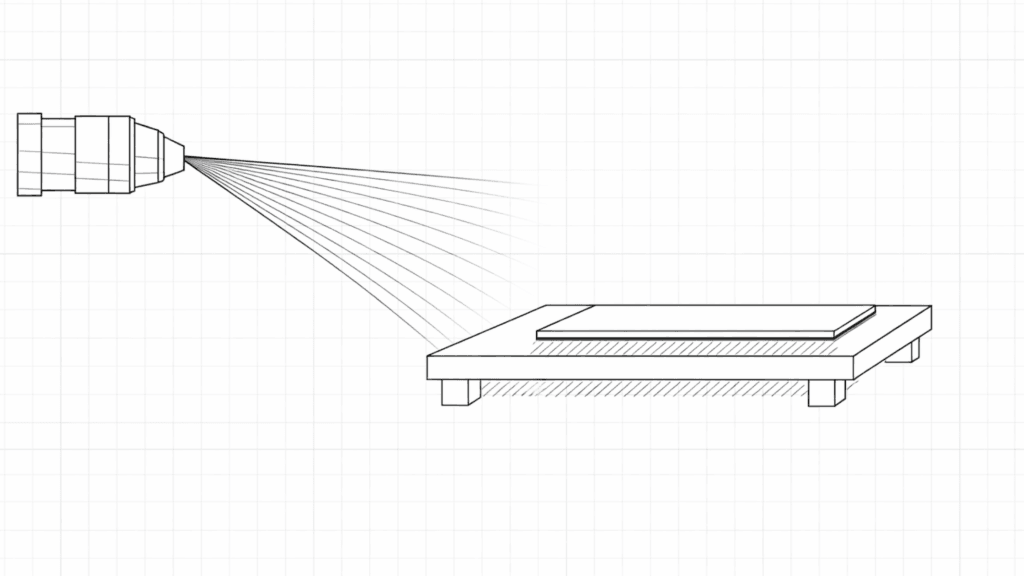
While academic texts break the process down into discrete stages—atomization, transport, evaporation, and decomposition—the actual performance of the method relies on how these stages are synchronized. In a lab environment, the method is only as good as the system’s ability to minimize environmental and human variables.
In most lab-scale spray pyrolysis setups, operating conditions tend to fall within predictable ranges. Substrate temperatures typically lie between 200–500°C depending on precursor chemistry. Nozzle-to-substrate distance is often maintained between 10–30 cm to balance evaporation and deposition. Spray rates generally range from ~1–10 ml/min for lab-scale systems, though this varies with solvent volatility. These are not fixed values, but they serve as a baseline for diagnosing whether a system is operating within a viable process window.
The 4 Parameters That Dictate Film Quality
Most research failures in spray pyrolysis are not due to chemistry, but to inconsistent parameter control.
- Substrate Temperature:
- This is not merely a setpoint; it is a stability requirement. If the heating block exhibits thermal gradients or drifts during the deposition, the resulting film will show localized variations in crystallinity and electrical conductivity.
- Droplet Size Distribution:
- This is governed by the atomization system. If the droplet size is inconsistent, the resulting film will suffer from surface roughness and poor morphology.
- Spray Rate:
- The rate of delivery must match the rate of decomposition. If the delivery is too fast, solvent accumulation leads to cracking or delamination; if too slow, the film becomes porous and non-adherent.
- Nozzle-to-Substrate Distance:
- This determines the time-of-flight for the droplet. If this distance is not precisely maintained, droplets arrive either too wet (causing pooling) or prematurely dried (leading to powdery, low-density films).
Typical film thickness in lab-scale spray pyrolysis ranges from tens of nanometers to several micrometers, depending on spray cycles and precursor concentration. Film growth regimes (droplet impact vs vapor-phase decomposition) can shift depending on substrate temperature and droplet evaporation rate, directly affecting density and adhesion.
Common Failure Modes in Spray Pyrolysis (And Root Causes)
In practice, most deposition issues can be traced back to a small set of parameter mismatches. The following mapping is commonly observed in lab-scale systems:
| Observed Issue | Likely Cause | Parameter to Adjust |
| Film cracking | Excess spray rate / solvent accumulation | Reduce spray rate |
| Powdery film | Droplets drying mid-air | Reduce nozzle distance |
| Non-uniform thickness | Poor motion control | Introduce stage/nozzle movement |
| Poor adhesion | Low substrate temperature | Improve substrate temperature stability |
| Pinholes in film | Excess solvent evaporation rate | Adjust spray rate and substrate temperature balance |
This mapping reduces troubleshooting time significantly, especially in early-stage experiments.
Where Spray Pyrolysis Wins
For many applications, spray pyrolysis is the preferred thin film deposition method when scalability and experimental flexibility outweigh atomic-level precision.
- Perovskite Solar Cells: Offers a scalable pathway for depositing absorber layers with reduced defect densities compared to manual methods.
- Metal Oxide Thin Films (ZnO, TiO₂): Essential for optoelectronics where cost-effective, large-area fabrication is required.
- Gas Sensors: Allows for the deliberate engineering of film porosity, which is vital for maximizing sensor sensitivity.
- Energy Storage Materials: Ideal for depositing consistent electrode coatings for battery research.
Conversely, if your research requires atomic-level conformal coatings on complex 3D geometries, vacuum-based techniques like ALD or CVD remain the correct choice. If your application prioritizes large-area uniformity and cost-efficient scaling, spray pyrolysis is typically preferred. If it prioritizes atomic-level conformity or ultra-thin precision layers, vacuum-based methods remain more appropriate. Recognizing these boundaries is essential for aligning your procurement with your research objectives.
This becomes critical when in environments prioritizing rapid experimentation cycles.
Spray Pyrolysis vs Spin Coating vs CVD
A common evaluation query in research environments is whether spray pyrolysis can replace other deposition methods. This comparison reflects common evaluation queries such as ‘spray pyrolysis vs spin coating’ and ‘spray pyrolysis vs CVD’.
| Method | Cost | Scalability | Precision | Use Case |
|---|---|---|---|---|
| Spray Pyrolysis | Low | High | Medium | Large-area, metal oxides |
| Spin Coating | Low | Low | Medium | Small samples |
| CVD | Very High | High | Very High | High-purity films |
| Sputtering | High | Medium | High | Controlled thin films |
Spray pyrolysis is preferred when scalability and cost efficiency take precedence over atomic-level control. Spray pyrolysis occupies a distinct position in the deposition spectrum—enabling controlled thin-film growth at scale without the infrastructure complexity of vacuum systems.
Why Spray Pyrolysis Equipment Design Matters
Two labs using identical chemistry often report different outcomes. The disparity lies in the engineering.
Counterintuitively, increasing atomization precision does not always improve film quality. Extremely fine droplets can evaporate before reaching the substrate, leading to powdery deposition instead of continuous films. In such cases, slightly larger droplet sizes produce more stable coatings.
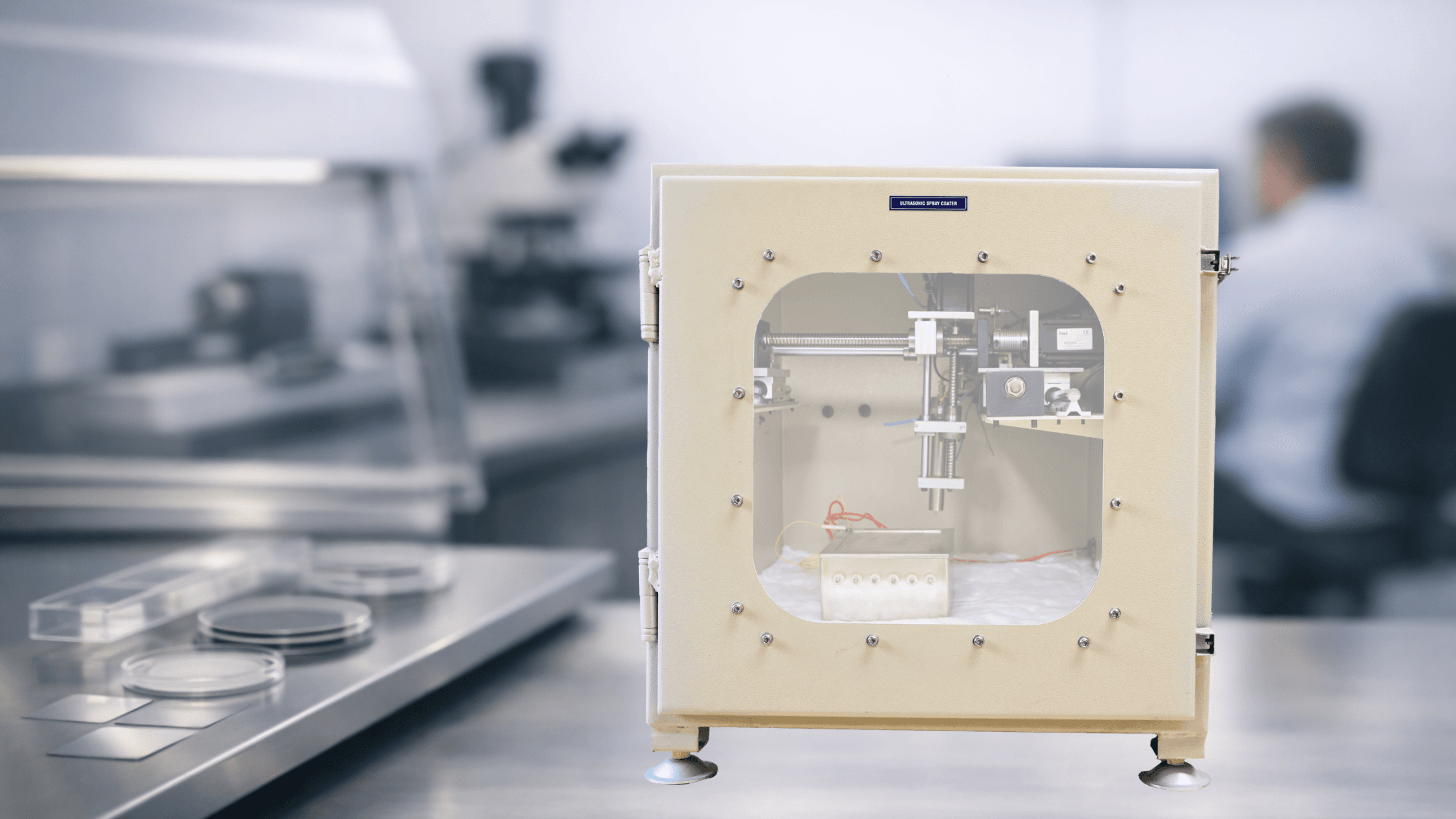
A reliable system must integrate stable atomization, uniform thermal management, and programmable motion control. In high-output environments—such as IISc, IITs, and research clusters in Pune and Bengaluru—manual control typically results in significant time loss due to repeated calibration and failed runs.
Film uniformity is typically influenced by both droplet impingement dynamics and solvent evaporation kinetics, which vary with substrate temperature and carrier gas flow. A properly configured system, by contrast, should achieve thickness variation below ±5% and reproducibility exceeding 90%. This is a key consideration when selecting a spray pyrolysis system or comparing spray pyrolysis equipment across vendors.
Procurement Logic: The “Value” Shift
While lab-scale systems in resource-optimized research environments generally range from ₹3–6 lakh, focusing solely on the spray pyrolysis machine price in India is a tactical error. This becomes a key consideration for labs comparing spray pyrolysis equipment price in India across vendors. The true cost of a spray pyrolysis system for research labs is the cumulative time lost to failed experiments and constant recalibration. A system that reduces experimental iteration from five cycles to two effectively halves both material consumption and researcher time, which, in most academic labs, is the more constrained resource.
This is particularly relevant when selecting a spray pyrolysis system for research labs where reproducibility and throughput are critical.
In India, many lab purchases are tied to grant cycles from agencies such as DST, CSIR, or DRDO. Systems within the ₹3–6 lakh band often align with rapid deployment cycles in Indian research environments, without compromising core process control requirements.
Most procurement failures originate from incomplete technical inputs rather than equipment limitations. Ensure your internal requirements are clearly defined:
- Substrate specifications: size and material compatibility.
- Process requirements: target temperature ranges and atmospheric sensitivity (e.g., inert gas requirements for perovskites).
- Automation levels: requirements for multi-layer deposition or large-area scanning.
When to Move from Manual to Automated Spray Pyrolysis
For research lab-scale settings working on perovskites, metal oxides, or energy materials, the transition from a “method” to a “reliable process” depends on how precisely the system is configured. The transition typically becomes necessary when:
- Experimental results cannot be reproduced consistently
- More than 2–3 iterations are required to stabilize a process
- Substrate size exceeds manual control limits
- Multi-layer deposition becomes routine
- Process results vary significantly between operators
At this stage, the limitation is no longer experimental—it is infrastructural.
For example, perovskite deposition typically requires controlled atmosphere shielding, while metal oxide films rely more heavily on substrate temperature stability and spray rate control.
Moving Toward Configuration
The repeatable system behavior depends on how precisely the system is configured for the material system at hand. If your lab is working on perovskites, metal oxides, or energy materials, avoid generic comparisons and instead define requirements based on your specific spray pyrolysis system configuration needs.
The next step is to define your application requirements clearly. A well-structured RFQ—one that specifies your substrate size, material sensitivity, and reproducibility targets—will return more than just a price. It will provide a technical configuration aligned to your research, expected performance benchmarks, and the operational constraints of your lab.
At this stage, equipment performance directly influences experimental output quality and throughput. Process stability is also influenced by precursor concentration and carrier gas flow uniformity, which affect droplet residence time and deposition kinetics.
Submit your substrate dimensions, precursor chemistry, and target film characteristics to receive a system configuration with expected process windows and performance benchmarks.