
Designing a Laboratory Spray Pyrolysis Setup for Reproducible Thin-Film Deposition Research
Repeatable thin-film deposition requires more than selecting an appropriate precursor chemistry. In laboratory spray pyrolysis research, substrate temperature stability, precursor delivery, spray characteristics, and deposition parameter control collectively determine film quality and experimental reproducibility.
Researchers working on metal oxide thin-film research, transparent conducting oxides, perovskites, and nanomaterials require configurable laboratory spray pyrolysis systems that support process optimization, experimental reproducibility, and reproducible thin-film deposition workflows.
Key Takeaways
- Process repeatability is critical for thin-film research.
- Substrate temperature control significantly affects film quality.
- Spray parameter optimization influences coating uniformity.
- Configurable laboratory workflows improve experimental reproducibility.
- Research-oriented system architecture supports future experimental requirements.
Why Spray Pyrolysis Setup Design Matters In thin-film deposition research, achieving reproducible results can be challenging when process parameters are not adequately controlled. As film properties are influenced by:
Why Spray Pyrolysis Setup Design Matters
In thin-film deposition research, achieving reproducible results can be challenging when process parameters are not adequately controlled. As film properties are influenced by:
- Substrate temperature
- Precursor concentration
- Carrier gas flow
- Spray rate
- Nozzle-to-substrate distance
- Deposition time
- Thermal stability
Small variations in these parameters can lead to inconsistent film morphology, thickness variations, and reduced experimental repeatability. Hence for laboratory-scale research, system design should prioritize process control rather than simply enabling material deposition.
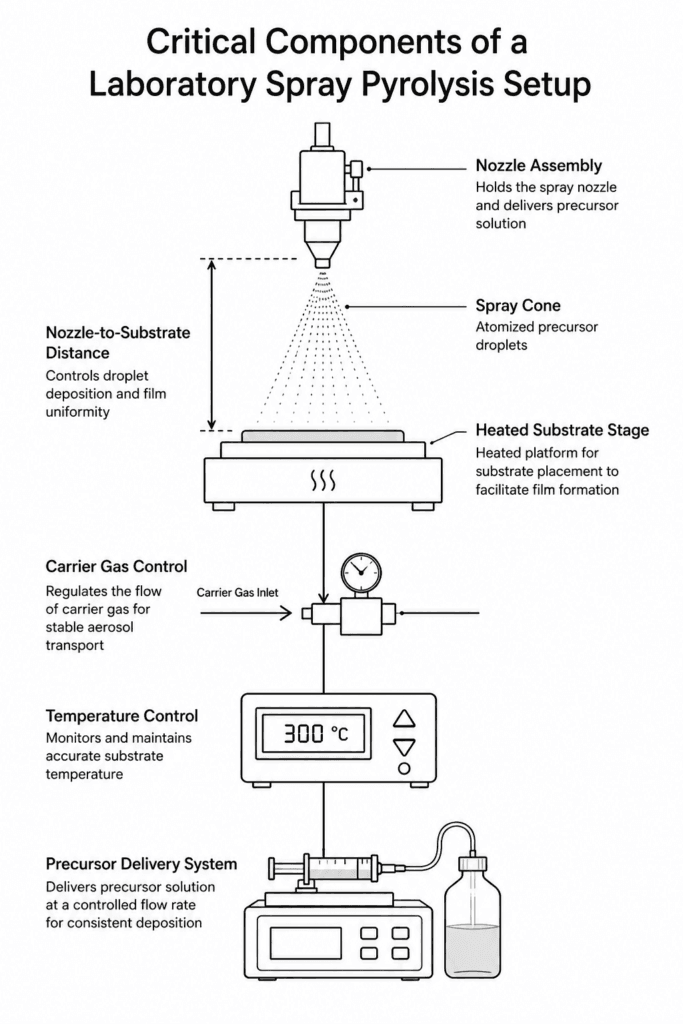
Critical Components of a Laboratory Spray Pyrolysis System
A reproducibility-focused spray pyrolysis setup should support flexible process optimization across different thin-film applications.
| Component | Research Consideration |
|---|---|
| Heated Substrate Stage | Thermal stability and film crystallinity |
| Precursor Delivery System | Flow rate consistency |
| Spray Nozzle Configuration | Film uniformity and droplet characteristics |
| Carrier Gas Control | Stable aerosol transport |
| Deposition Parameter Control | Experimental repeatability |
The ability to configure and optimize these parameters is often more valuable than selecting a fixed deposition configuration.
Critical Process Parameters Affecting Thin-Film Quality
Researchers should consider the following process variables during system selection and workflow design.
| Process Variable | Impact on Thin Films |
|---|---|
| Substrate Temperature | Crystallinity, adhesion & phase formation |
| Spray Rate | Surface morphology & film density |
| Nozzle Distance | Coating uniformity & droplet evaporation |
| Carrier Gas Flow | Droplet transport & deposition uniformity |
| Precursor Concentration | Film composition, morphology & thickness |
| Deposition Time | Film thickness & surface coverage |
| Thermal Stability | Process repeatability & reproducibility |
Experimental reproducibility depends on controlling these variables consistently across multiple deposition cycles.
Designing Repeatable Research Workflows
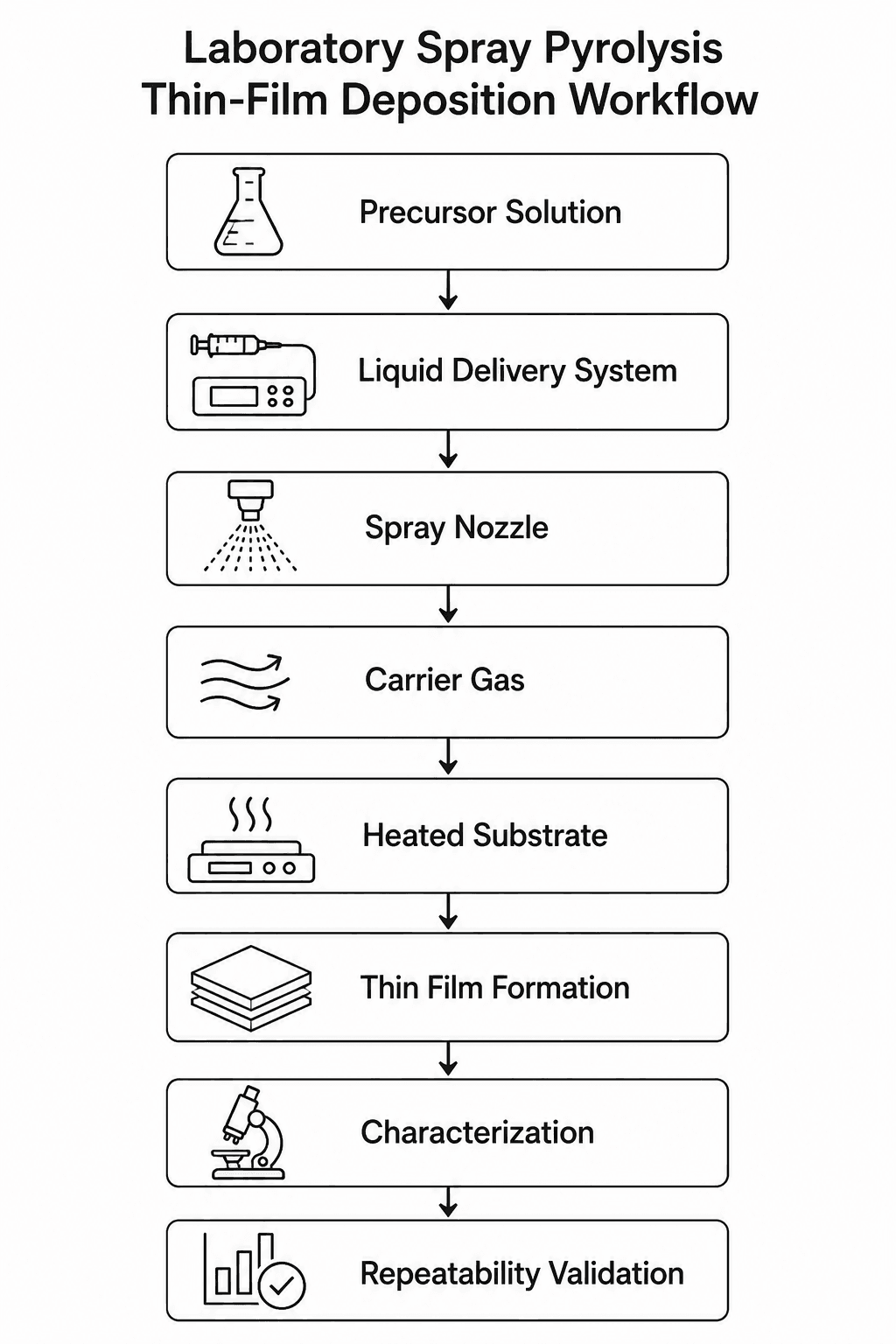
Laboratory spray pyrolysis systems should support the entire experimental workflow, and typical thin-film deposition workflows include:
- Precursor preparation.
- Process parameter setup / Recipe programming.
- Substrate temperature stabilization.
- Automated thin-film deposition.
- Film characterization.
- Repeatability validation.
Research projects often require iterative parameter optimization. Consequently, workflow adaptability is an important consideration for materials science laboratories.
Thin-Film Research Applications
Laboratory spray pyrolysis systems are a specialized category of thin-film deposition equipment commonly used for:
- ZnO thin films
- TiO₂ thin films
- SnO₂ thin films
- Transparent conducting oxides
- Perovskite thin films
- Functional nanomaterial coatings
- Advanced materials research
The suitability of a laboratory spray pyrolysis system should be evaluated based on the specific process requirements of the intended research application.
Expert Insight
Many thin-film deposition challenges originate from experimental variability rather than material limitations. Researchers frequently focus on precursor chemistry while overlooking the importance of thermal stability, process parameter documentation, and workflow consistency.
When selecting a spray pyrolysis setup, prioritizing reproducibility and process control can significantly improve the reliability of thin-film research outcomes.
Supporting Research Workflows
Research laboratories frequently require configurable process parameter control for thin-film process optimization and repeatable deposition experiments. The NTPY01 Spray Pyrolysis System is designed to support reproducible laboratory workflows across advanced materials research applications, including:
- Thin-film process optimization
- Metal oxide thin-film research
- Laboratory-scale spray pyrolysis deposition
- Research-oriented experimental workflows
Its configurable architecture enables researchers to optimize deposition parameters according to evolving experimental requirements.
Procurement Considerations for Research Laboratories
Before selecting a laboratory spray pyrolysis system, researchers should evaluate:
- Process parameter requirements
- Material compatibility
- Temperature control capabilities
- Configuration flexibility
- Workflow flexibility
- Documentation requirements
- Technical support availability
- Future scalability of research projects
Institutional procurement decisions increasingly favour laboratory equipment that supports reproducible and configurable research workflows.
Frequently Asked Questions
A laboratory spray pyrolysis setup is a thin-film deposition system that atomizes precursor solutions and deposits them onto heated substrates under controlled experimental conditions.
Substrate temperature, precursor concentration, carrier gas flow, nozzle distance, spray rate, and deposition time all influence experimental repeatability.
Spray pyrolysis is widely used for laboratory-scale metal oxide thin-film deposition because it enables researchers to optimize substrate temperature, precursor chemistry, and deposition parameters across a wide range of materials systems.
Researchers should evaluate process control capabilities, workflow configurability, material compatibility, and technical support for their specific research applications.
Research Validation
The NTPY01 Spray Pyrolysis System has been used in peer-reviewed thin-film deposition research investigating the optical, structural, and electrical properties of spray pyrolysis deposited Cu₂Cd₁₋ₓMnₓSnS₄ thin films. The published experimental methodology reports controlled deposition parameters, including substrate temperature, precursor flow rate, nozzle-to-substrate distance, and deposition duration, demonstrating the suitability of laboratory-scale spray pyrolysis systems for reproducible materials research workflows.
Request Technical Consultation
Thin-film deposition workflows vary significantly depending on material systems, substrate requirements, and experimental objectives. Researchers may require different deposition configurations and process parameter recommendations for reproducible laboratory-scale experiments.
Request Technical Quote for Your Research Application — Discuss Your Thin-Film Deposition Requirements