
Spin Coater for Perovskite Solar Cell Research
Perovskite solar cell research often depends on repeatable thin-film deposition. For small-area laboratory devices, spin coating is a well-established laboratory method for depositing solution-processed perovskite and related thin-film layers. A suitable research spin coater gives researchers control over variables such as rotational speed, acceleration, process time and substrate handling, while allowing the defined equipment-side process parameters to be reproduced from one experiment to another.
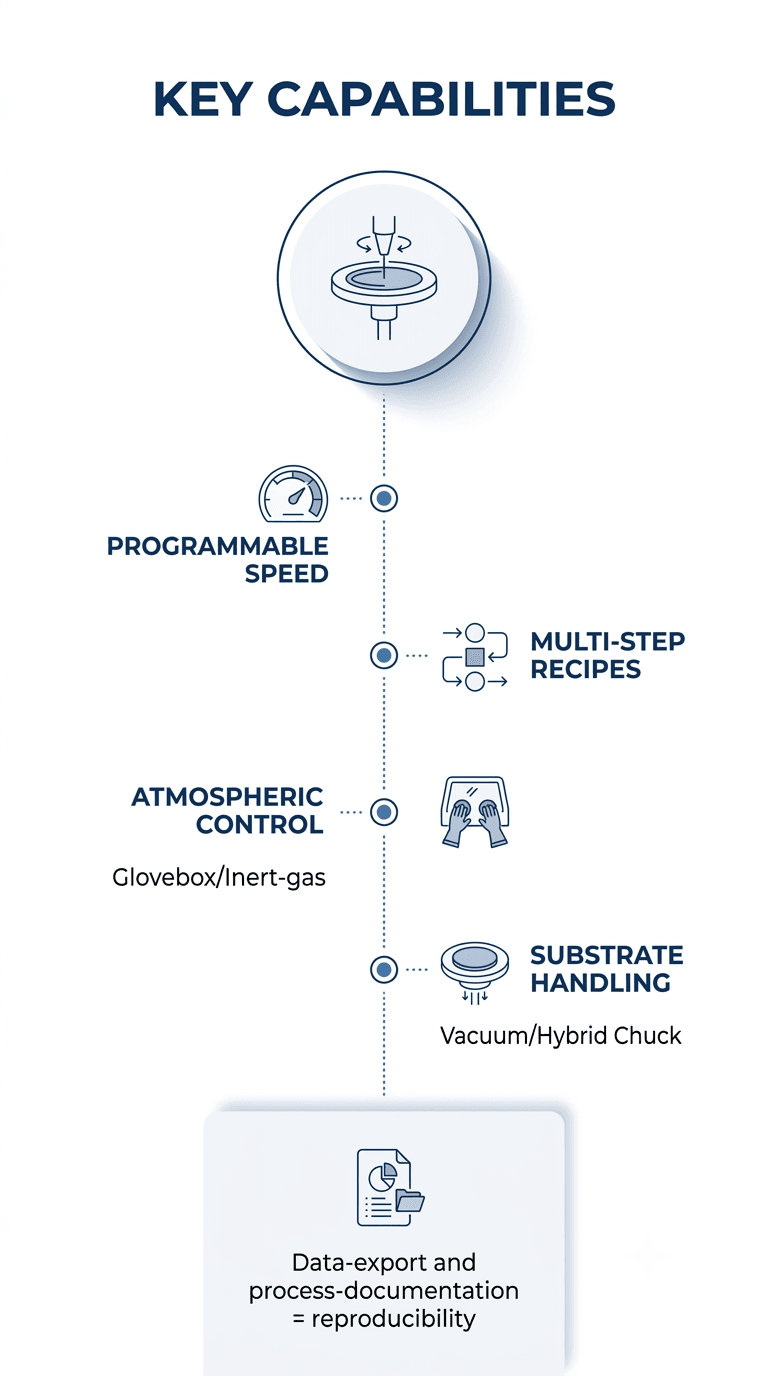
For researchers selecting a spin coater for perovskite solar cells, maximum RPM is only one specification. The more important question is whether the system can reproduce the required spin profile, substrate handling, atmosphere and process conditions across repeated experiments.
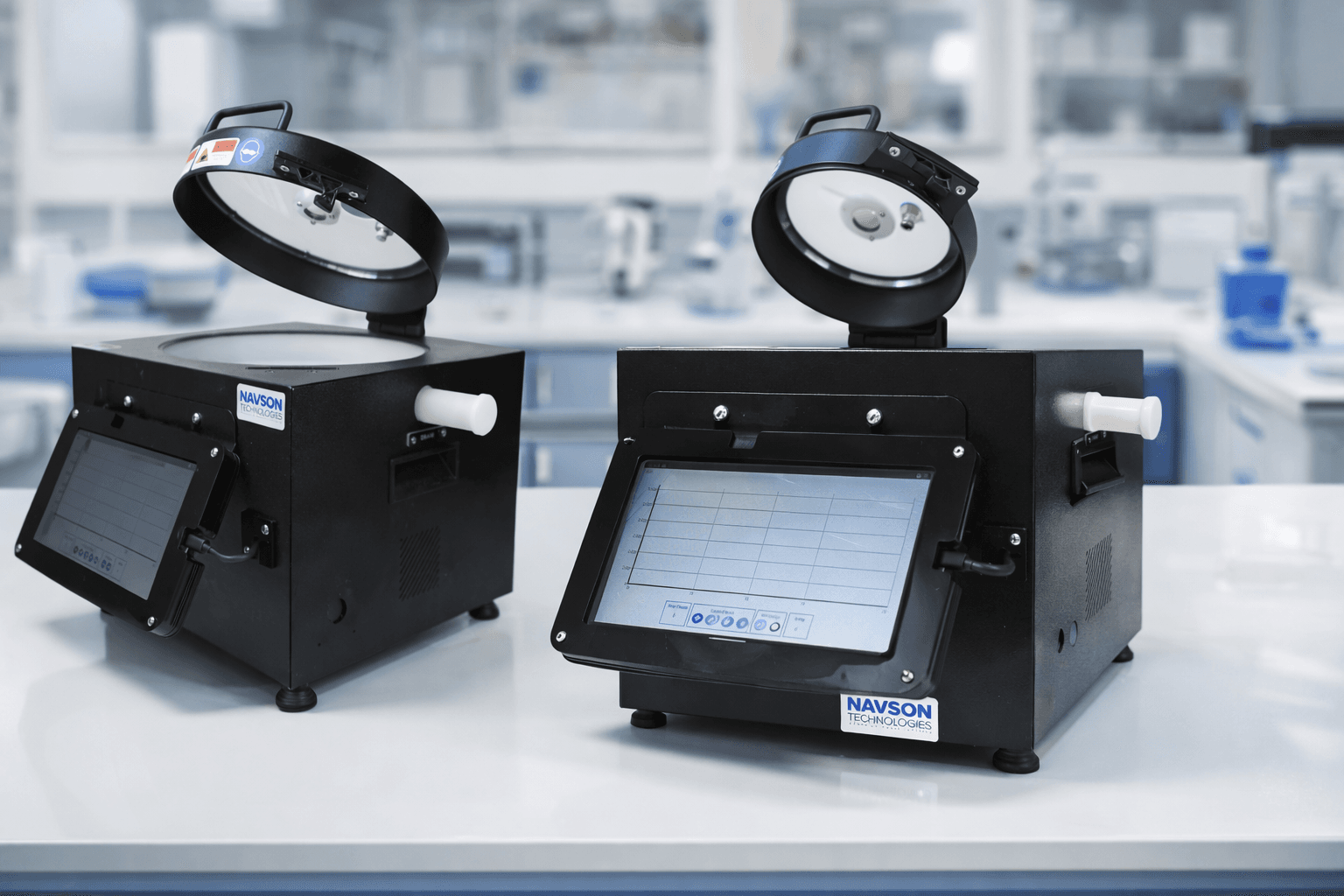
The Navson NT12000 Series is a research spin-coating platform designed for controlled thin-film deposition, with configurations supporting perovskite photovoltaic research among other applications.
Quick answer: What should a perovskite research spin coater provide?
A spin coater for perovskite solar cell research should provide:
- Stable and programmable rotational speed.
- Controlled acceleration and deceleration.
- Repeatable multi-step coating recipes.
- Appropriate vacuum, vacuum-less or hybrid substrate handling.
- Compatibility with glovebox or controlled-atmosphere workflows when required.
- Nitrogen or inert-gas purging where the experimental process calls for it.
- Suitable substrate-size capacity.
- Reproducible process settings and run records.
- Optional heating or other accessories when required by the research workflow.
- Chamber materials and cleaning procedures compatible with the laboratory’s solvents and contamination-control requirements.
The equipment controls the mechanical part of the spin-coating process. It does not, by itself, guarantee a particular perovskite film morphology, crystal structure, power-conversion efficiency or device lifetime. Those outcomes also depend on precursor chemistry, substrate preparation, solvent system, atmosphere, temperature, deposition timing, annealing and other process variables.
Why is spin coating used for perovskite solar cells?
Spin coating is widely used in laboratory-scale perovskite photovoltaic research because it provides a relatively simple way to deposit solution-based thin films on small substrates while precisely controlling the rotational process.
In a typical spin-coating process, a coating solution is dispensed onto a substrate and the substrate is rotated at a defined speed. Rotation spreads the liquid across the substrate while the imposed rotational motion, fluid properties and solvent evaporation contribute to the evolution of the wet film. Researchers can then control the spin profile and other process parameters as part of a defined experimental recipe.
Spin coating is particularly established in small-area perovskite research. A Nature Reviews Materials review notes that small-area devices below approximately 1 cm² are typically fabricated using spin coating, while also explaining why the method becomes less suitable for the large areas required for commercialization.
This makes a laboratory spin coater particularly relevant for:
- Perovskite absorber-layer research.
- Charge-transport-layer deposition.
- Interface and surface-engineering studies.
- Materials and formulation screening.
- Process optimization.
- Small-area device fabrication.
- Repeatability studies.
- Academic and industrial R&D.
The spin coater is therefore a process-control instrument within a larger perovskite device-fabrication workflow, rather than the complete fabrication system.
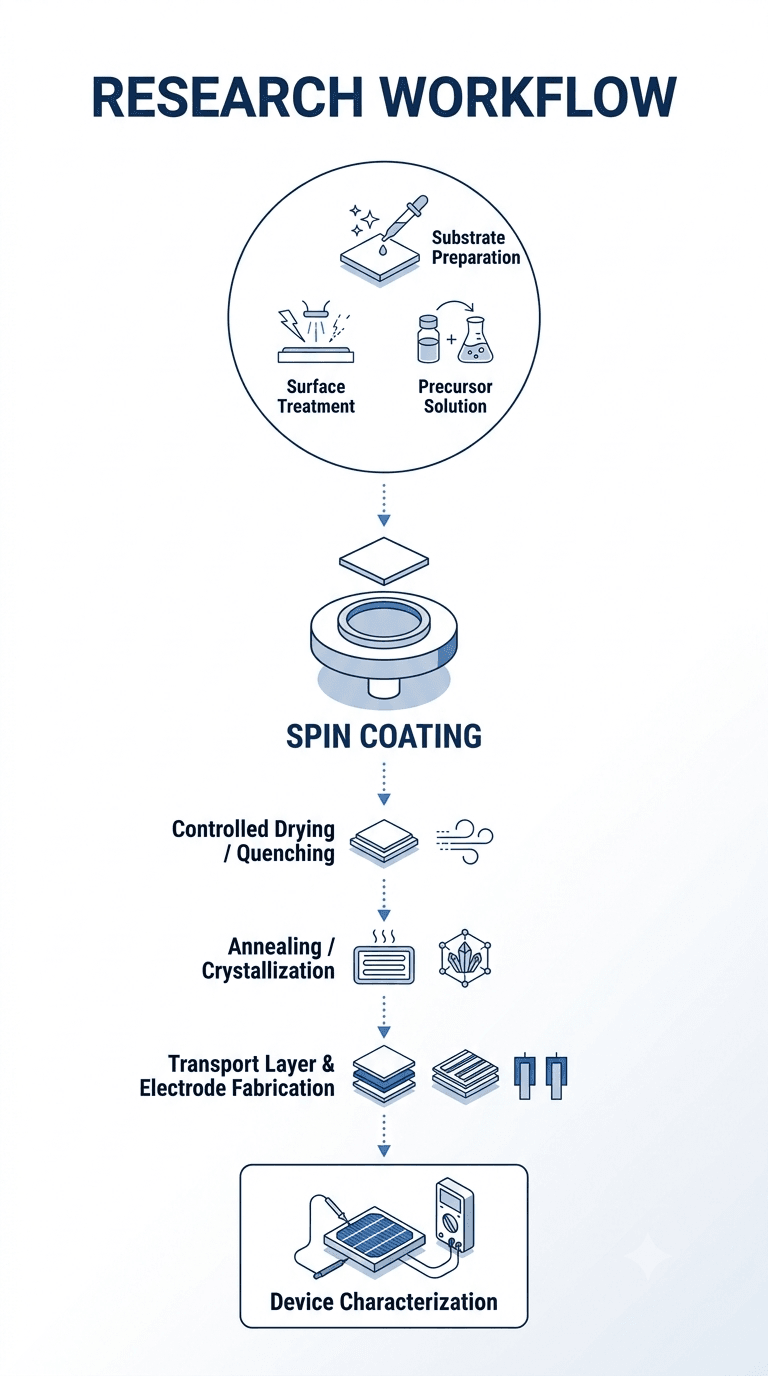
Where does the spin coater fit in a perovskite solar cell research workflow?
A simplified laboratory workflow can be represented as:
Substrate preparation
↓
Surface/interface treatment
↓
Precursor or coating-solution preparation
↓
Spin coating
↓
Controlled drying, quenching or subsequent treatment
↓
Annealing/crystallization
↓
Transport-layer and electrode fabrication
↓
Device characterization
The exact sequence varies substantially between perovskite compositions, device architectures and research protocols. The spin coater primarily controls the rotation-based deposition stage. Its value is greatest when the laboratory needs defined mechanical deposition parameters to be repeated and documented across samples or experiments.
What researchers should look for in a spin coater for perovskite research
1. RPM control
Rotational speed is one of the fundamental variables in a spin-coating recipe. However, maximum RPM should not be treated as the only specification that matters. A research instrument should provide sufficient control and accuracy to implement the speed profile required by the experimental protocol.
Important specifications include:
- Minimum and maximum RPM.
- RPM accuracy.
- Speed stability.
- Programmable speed steps.
- Process-time control.
- Acceleration and deceleration control.
For example, the NT12000 Series is specified for a 50–12,000 RPM operating range with ±1% RPM accuracy. The 10-inch model also specifies acceleration capability up to 8,000 RPM/s and programmable acceleration/deceleration profiles.
The appropriate RPM for a perovskite process should come from the validated experimental protocol rather than from a generic recommendation. Different precursor systems and coating methods can require substantially different process conditions.
2. Acceleration and deceleration control
Two spin coaters can reach the same final RPM while producing different process profiles if their acceleration characteristics differ. So acceleration affects how quickly the substrate reaches the programmed rotational speed. Because acceleration determines how quickly the substrate reaches the programmed rotational speed, it can be an important equipment parameter when the experimental protocol specifies a defined speed-time profile.
A research-grade spin coater should allow the researcher to reproduce not just the final RPM but the intended speed-time profile. The NT12000 provides programmable acceleration and deceleration profiles and displays RPM, time and ramp information during operation.
3. Recipe reproducibility
For research laboratories, recipe management can be more valuable than an unusually high maximum RPM. A useful spin-coating recipe can contain defined process stages for:
- RPM.
- Dwell time.
- Acceleration/ramp profile.
- Multiple sequential steps.
- Other configured process parameters.
The NT12000 supports multi-step recipes, with up to 10 steps per program specified on the current product page, and storage for virtually unlimited recipes. Run information can also be exported through USB for record-keeping and process documentation.
This supports a more controlled experimental workflow: researchers can save a defined process rather than manually reconstructing the same sequence for every sample.
Recipe storage does not itself prove that a coating will be identical from run to run. Reproducibility also depends on substrate condition, solution preparation, dispensing, environmental conditions, equipment cleanliness and other variables.
Glovebox compatibility for perovskite research
Atmospheric control can be important in perovskite research because moisture and oxygen can affect materials chemistry and film formation, depending on the process and material system. Research into ambient fabrication also demonstrates that atmospheric conditions can influence precursor chemistry and perovskite crystallization.
Where a laboratory process requires controlled-atmosphere deposition, the spin coater may need to operate inside or integrate with a glovebox. This creates practical equipment requirements:
The NT12000-10 is glovebox compatible and tested for antechamber transfer. It also supports remote operation from up to 10 m, including operation from outside the glovebox, with a wall-mounted UI option.
- Physical compatibility with the glovebox.
- Suitable dimensions for antechamber transfer.
- Appropriate electrical and control arrangements.
- Remote operation where direct access to the instrument is restricted.
- Compatibility with the laboratory’s gas and process infrastructure.
For a laboratory purchasing a spin coater for glovebox use, these physical integration requirements should be confirmed against the actual glovebox dimensions and configuration before procurement.
Nitrogen purging
Nitrogen purging is another useful capability for laboratories working with processes requiring an inert or controlled atmosphere.
A nitrogen connection does not mean that every perovskite coating process requires nitrogen. The appropriate atmosphere depends on the material system and experimental protocol. The relevant procurement question is whether the spin coater can support the atmosphere required by the laboratory’s established process.
The NT12000-10 specification includes a pneumatic connection in the lid for nitrogen purging. This is relevant where the laboratory’s established spin-coating protocol specifies an inert-gas atmosphere.
Vacuum, vacuum-less and hybrid substrate handling
Substrate holding is another important consideration. A laboratory may work with:
- Rigid substrates.
- Different substrate dimensions.
- Substrates that can be held using vacuum.
- Substrates better suited to vacuum-less handling.
- Different substrate formats during method development.
The appropriate holding configuration can therefore be selected according to the substrate and process rather than applying one chucking method to every experiment.
The NT12000 Series supports vacuum, vacuum-less and hybrid substrate-holding configurations. The current 10-inch specifications list substrate handling from 5 to 200 mm diameter, with customized chuck options available for different substrate requirements.
The correct chuck should be selected according to substrate geometry, material, backside condition, vacuum compatibility and the laboratory’s actual process.
Optional IR heating
Some thin-film workflows incorporate controlled heating before, during or after deposition. For those applications, integrated heating option can simplify workflows in which the substrate must be temperature-controlled within the coating system.
The NT12000-10 lists optional IR heating from room temperature to 200°C.
Whether this capability should be included in a perovskite research configuration depends on the specific process. Heating requirements should be defined from the experimental protocol rather than assuming that every spin-coating recipe requires in-situ heating.
NT12000 for perovskite solar cell research
The NT12000 Series is a research spin-coating platform from Navson Technologies designed for precision thin-film deposition. Its application range includes perovskite photovoltaic layers as well as photoresist lithography, OLED/quantum-dot deposition, ceramic coatings, MEMS/NEMS films and photonic coatings.
Published research also documents use of the NT12000 in thin-film and materials-science experiments, providing application evidence beyond the manufacturer’s specification sheet.
For perovskite research, the relevant capabilities include:
| Requirement | NT12000 capability |
| Controlled rotational speed | 50–12,000 RPM |
| RPM accuracy | ±1% |
| Acceleration control | Programmable acceleration/deceleration |
| Maximum specified acceleration | Up to 8,000 RPM/s on NT12000-10 |
| Recipe control | Up to 10-step programmable recipes |
| Recipe storage | Virtually unlimited programs |
| Process monitoring | Live RPM/time/ramp display |
| Run documentation | USB run-log export |
| Substrate holding | Vacuum, vacuum-less and hybrid configurations |
| Nitrogen purging | Available on NT12000-10 |
| Glovebox integration | Documented for NT12000-10 |
| Remote operation | Up to 10 m on NT12000-10 |
| IR heating | Optional, RT–200°C on NT12000-10 |
| Working chamber | Natural polypropylene |
| Substrate capacity | Up to 200 mm on NT12000-10 |
Specifications and available configurations should be confirmed against the current product quotation because accessories and customization can vary by configuration.
Research evidence for NT12000 use
Published research provides independent application evidence for the NT12000 beyond its manufacturer specifications.
In a 2024 Small paper, Chen et al. explicitly identify the Navson NT12000 Spin Coater as the instrument used for spin coating PDMS and hydroxyapatite nanorod suspensions. The reported processes included 5,000 rpm and 8,000 rpm spin steps. Wiley Online Library
The NT12000’s use in the fabrication of PMMA-LZO composite dielectric thin films is reported in the Journal of Electronic Materials (2019).
NT12000 6-inch vs 10-inch: which configuration is appropriate?
The primary distinction between the two NT12000 configurations is substrate capacity. Navson’s NT12000 (6″) supports substrates up to 100 mm, while the NT12000 (10″) supports substrates up to 200 mm.
| Consideration | NT12000 (6″) | NT12000 (10″) |
| Maximum stated substrate capacity | Up to 100 mm | Up to 200 mm |
| Platform | NT12000 Series | NT12000 Series |
| Recipe-based operation | Yes | Yes |
| Vacuum/vacuum-less/hybrid handling | Available | Available |
| Perovskite research | Suitable where substrate capacity matches process | Suitable where larger substrate capacity is required |
| Glovebox integration | Configuration dependent | Documented glovebox compatibility |
For a laboratory working primarily with substrates up to 100 mm, the 6-inch configuration may provide sufficient capacity. Laboratories working with substrates up to 200 mm, or planning for larger substrates, can evaluate the 10-inch configuration. The decision should be based on actual substrate dimensions and future process requirements—not on the assumption that the larger bowl automatically produces better films.
Common spin-coating problems in perovskite research
A spin coater can provide repeatable mechanical parameters, but inconsistent films can originate elsewhere in the process.
Film thickness varies between samples
Check:
- Precursor concentration.
- Solution viscosity.
- Dispensing volume.
- Dispensing timing.
- Substrate surface condition.
- RPM.
- Acceleration.
- Spin time.
- Ambient conditions.
- Equipment cleanliness.
Changing the spin speed alone may not resolve a variation caused by precursor chemistry or substrate preparation.
Film morphology changes between runs
Potential variables include:
- Precursor aging.
- Solvent composition.
- Humidity and oxygen exposure.
- Substrate treatment.
- Dispensing timing.
- Spin profile.
- Temperature.
- Quenching or antisolvent conditions.
The spin coater should therefore be treated as one controlled component of the experimental system.
Samples move during spinning
Review:
- Chuck selection.
- Substrate dimensions.
- Vacuum level where applicable.
- Substrate backside condition.
- Chuck cleanliness.
- Mechanical alignment.
- Acceleration
Vacuum-less or hybrid chuck configurations may be useful where conventional vacuum holding is unsuitable, depending on the substrate.
Spin coating versus scalable perovskite coating
Spin coating is highly relevant to laboratory research, but it should not be confused with a universal manufacturing solution. Peer-reviewed reviews identify spin coating as a common method for small-area perovskite devices while noting limitations when moving toward large-area substrates. Alternative approaches investigated for scale-up include blade coating, slot-die coating, spray-based deposition, inkjet printing and other scalable deposition methods.
This distinction matters when purchasing equipment. A laboratory developing a new perovskite material, interface, precursor or device architecture may need precise and repeatable spin coating. A manufacturing-development team working toward large-area modules may require a different deposition platform altogether.
The correct equipment therefore depends on the research stage and intended substrate scale.
How to specify a spin coater for perovskite research
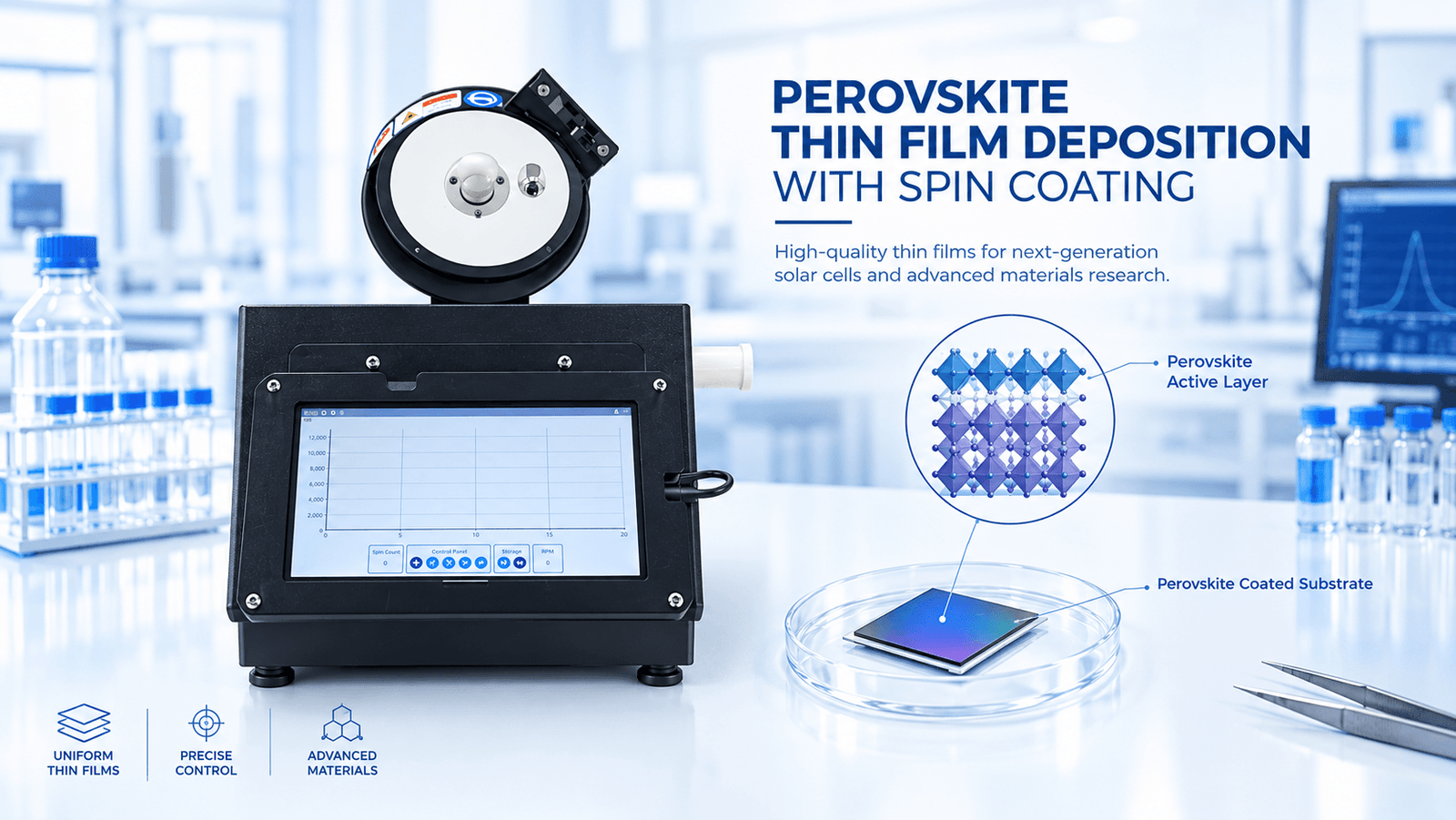
When specifying a perovskite spin coating machine, define the substrate, spin profile, atmosphere, chuck and process-documentation requirements before comparing equipment.
Step 1: Define the substrate
Specify:
- Substrate material.
- Substrate dimensions.
- Maximum diameter or length.
- Thickness.
- Rigid or flexible format.
- Expected future substrate size.
Step 2: Define the spin profile
Specify:
- Minimum RPM.
- Maximum RPM.
- Required RPM accuracy.
- Acceleration/deceleration requirements.
- Number of recipe stages.
- Maximum process time.
Step 3: Define the atmosphere
Determine whether the process requires:
- Ambient operation.
- Nitrogen purging.
- Glovebox operation.
- Other controlled-atmosphere arrangements.
Step 4: Define substrate holding
Determine whether you require:
- Vacuum chuck.
- Vacuum-less chuck.
- Hybrid chuck.
- Customized substrate holding.
Step 5: Define thermal requirements
If the workflow requires controlled heating, specify the required temperature range and whether heating must occur within the spin-coating system.
Step 6: Define process documentation
For research environments, consider whether the system should provide:
- Recipe storage.
- Run records.
- RPM/time monitoring.
- Data export.
- User access control or other laboratory documentation requirements.
Step 7: Define laboratory integration
For glovebox or controlled laboratory environments, verify:
- Instrument dimensions.
- Antechamber dimensions.
- Electrical requirements.
- Gas connections.
- Remote-control requirements.
- Drainage/waste handling.
- Maintenance access.
What matters most when specifying a perovskite spin-coating system?
A practical procurement hierarchy is:
1. Process compatibility: Can the instrument reproduce the laboratory’s required coating profile?
2. Substrate compatibility: Can the chuck reliably hold the substrates used in the research?
3. Environmental compatibility: Can it operate in the required ambient, nitrogen-purged or glovebox workflow?
4. Repeatability and recipe control: Can researchers reproduce the same defined process?
5. Chemical and contamination considerations: Are chamber and wetted-area materials appropriate for the laboratory’s solvents and cleaning procedures?
6. Data and documentation: Can the laboratory record and reproduce relevant process conditions?
7. Expansion capability: Can the equipment accommodate future substrate sizes or accessories?
8. Total procurement cost: Evaluate the complete configured system rather than only the base-machine price.
This approach is more useful than choosing a spin coater solely on maximum RPM.
Why a research-grade spin coater matters
As these variables change, controlling and documenting the equipment-side parameters becomes important. A research spin coater therefore functions as part of the laboratory’s experimental-control infrastructure: it helps define, reproduce and document the mechanical deposition conditions without eliminating the need to control chemistry, substrate preparation, atmosphere and downstream processing.
For the product-family specifications, see the NT12000 Series Spin Coaters. For the larger-substrate configuration, see the NT12000-10 specifications.
Frequently asked questions
A spin coater for perovskite solar cells is laboratory equipment used to deposit solution-based thin films by rotating a substrate at controlled speeds and process conditions. It is commonly used for small-area perovskite photovoltaic research.
There is no universal RPM for perovskite spin coating. The required speed depends on the precursor formulation, substrate, solvent system, deposition protocol and device architecture. The spin coater should therefore provide the range, accuracy and speed-time control required by the laboratory’s validated process.
Yes. Spin coating remains widely used for laboratory-scale perovskite solar-cell research, particularly for small-area devices and process development. It is less suitable as a direct manufacturing method for large-area commercial modules.
Yes, if the instrument is designed and configured for glovebox integration.
Not universally. Whether nitrogen or another controlled atmosphere is required depends on the specific material system and experimental process.
A vacuum chuck uses suction to hold a suitable substrate against the chuck surface. A vacuum-less configuration uses a mechanical or other non-vacuum holding approach. The appropriate option depends on substrate geometry, material and process requirements.
The relevant distinction is substrate capacity. The NT12000 (6″) supports substrates up to 100 mm, while the NT12000 (10″) supports substrates up to 200 mm.
Provide the substrate size and material, required RPM range, acceleration requirements, atmosphere requirements, chuck type, recipe requirements, heating requirements, glovebox constraints and any required data logging or automation. This allows the equipment configuration to be matched to the actual research process.
The key requirements are controllable RPM and acceleration, repeatable multi-step recipes, suitable substrate holding, compatibility with the required atmosphere, appropriate substrate capacity, and process documentation. Optional heating, glovebox integration and automation should be specified according to the laboratory’s actual process.
Not necessarily. Maximum RPM is only one equipment specification. The relevant process may depend on RPM stability, acceleration, timing, dispensing, substrate condition, solution properties and other variables.
Need a spin coater for perovskite solar cell research?
If you are specifying a spin coater for an academic, government or industrial R&D laboratory, provide the substrate dimensions, required spin profile, atmosphere, chuck requirements and any heating or automation requirements.
Explore the NT12000 Series Spin Coaters or contact Navson Technologies for a research-specific configuration.
Navson Technologies can configure the NT12000 Series around the laboratory’s substrate size, spin profile, atmosphere, chuck and accessory requirements.